

Protect The Job. Protect The Business.
A professional solar contract is not paperwork for the sake of it. It gives installer and customer a clear record of what was agreed before money, expectations or changes become a problem.
Clear Terms When Something Goes Wrong.
Scope, payment, variations, customer responsibilities, delays, existing systems, warranties and additional work are recorded clearly from the start.
If a problem develops later, you have professional written terms showing what both sides agreed.
Less Time Chasing Invoices Over Disputes.
A lot of payment chasing begins because the installer and customer disagree about completion, additional work, snagging, variations or when payment became due.
Put the payment stages and responsibilities in writing first and there is far less room for those arguments later.
Something To Point Back To When Memories Differ.
When a disagreement happens, one of the first questions is simple: what was actually agreed?
Our contracts give both installer and customer a clear point of reference. Disputes can often be resolved faster when the scope, payment terms and responsibilities were already written down before the installation began.
A Price Is A Price. No Hidden Extras.
As we say in the construction industry, a price is a price. You will not find a subscription waiting after checkout, a membership you have to join or another monthly cost just to keep using your paperwork.
Make one payment, download your professional solar contract and put it to work. You get unlimited downloads for two years, so you can download your documents as many times as you need during that period, including updated versions if we improve the documents.
Want The Whole Library? Get All 13.
One download gives your business the full collection of specialist solar contract templates.
The Solar Business Contract Template Bundle gives UK solar installers 13 specialist agreements covering the different types of work that can come through the door — rather than trying to force every solar project into one generic agreement.

Choose An Individual Contract From Our Solar Library.
If you only need paperwork for one particular type of work, browse our individual UK solar contract templates below and choose the agreement that matches the project you carry out.
↓Made For Solar Installers Working With Homeowners.
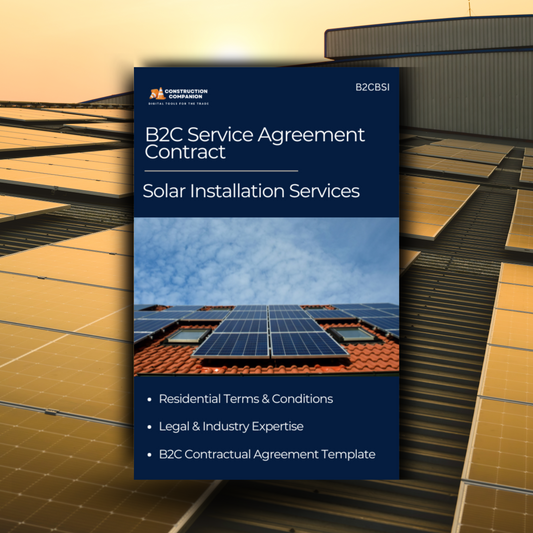
Our Solar Panel Installation Contract Template is built specifically for UK installers supplying and fitting residential solar PV systems for homeowners.
Homeowner projects create their own pressure points. Payment stages, performance expectations, panel layouts, variations, roof condition, existing electrics, DNO delays, snagging, warranties and final handover can all become disputes if expectations were not made clear before the work began.
This agreement is built from real residential solar experience and turns those known areas of disagreement into clear professional terms covering the installer, the homeowner and the project.


Handle Business Clients The Right Way.
Working for another business is different from working for a homeowner. Commercial solar projects need firmer terms, clearer responsibilities and properly defined payment triggers.
Our B2B Solar Installation Contract Template is built for UK solar installers working with builders, landlords, developers, contractors, commercial clients and other businesses where scope, programme, payment and responsibility need to be clearly documented.
The agreement is designed around the commercial situations contractors regularly face — including variations, staged payments, work by others, access delays, programme changes, additional works, snagging, handover and circumstances outside your control.
Clear payment triggers, variation procedures and defined responsibilities help reduce the scope for completed work or invoices to be withheld because of unrelated delays, defects elsewhere on the project or matters caused by another contractor.

One Project. Two Systems. Clear Responsibility.
Replacing a roof and installing solar at the same time creates responsibilities that a normal roofing contract or standard solar agreement does not properly cover on its own.
Our Roof Replacement with Solar Installation Contract Template is written specifically for UK roofers offering solar and solar installers delivering full roof renewals alongside a PV installation.
Developed with input from experienced roofing contractors, solar professionals and construction business owners, the contract reflects the real issues that arise when both scopes are delivered as one project — from strip-out and scaffolding through to panel installation, commissioning and final handover.
The agreement helps establish the boundaries between roofing responsibility, solar responsibility and later work carried out by third parties. This is especially important if panels, mounting equipment or other solar components need to be removed, disturbed or reinstated in the future so roof maintenance or repair work can take place.
Clear terms help avoid a future situation where damage caused during later maintenance, alterations or third-party work is automatically treated as the responsibility of the original roofing or solar installer.
Find The Contract Built For The Solar Work You Do.
Construction Companion is one of the UK’s leading specialist sources for solar contract templates, solar PV installation agreements and renewable energy business documents — trusted by professional solar installers and construction businesses across the UK.
Written With People Who Understand Solar Projects.
Specialist Contracts For Different Solar Work.
Because the work changes, the contract needs to change with it. Choose the agreement designed around the project you actually carry out.
Browse our specialist UK solar contract templates below — instant download, one-time payment and no subscription or membership.
-
Solar Business Contract Template Bundle
Regular price £19.99Regular priceUnit price per£48.99Sale price £19.99Sale -
B2B Solar Installation Contract Template
Regular price £19.99Regular priceUnit price per -
Solar Panel Installation Contract Template
Regular price £19.99Regular priceUnit price per -
Solar Lease Contract Template
Regular price £32.99Regular priceUnit price per -
Off-Grid Solar Installation Contract Template
Regular price £19.99Regular priceUnit price per -
Agricultural Solar Installation Agreement Template
Regular price £19.99Regular priceUnit price per -
EV Charger Installation Contract Bundle
Regular price £19.99Regular priceUnit price per -
Heat Pump Integration Agreement
Regular price £19.99Regular priceUnit price per -
Retrofit Solar Installation Contract Template
Regular price £19.99Regular priceUnit price per -
Roof Replacement with Solar Installation Contract Template
Regular price £19.99Regular priceUnit price per -
Solar Service & Maintenance Agreement Template
Regular price £19.99Regular priceUnit price per




Solar Contract Questions UK Installers Ask.
Our solar contracts are built around the questions and disputes that arise on real UK solar projects. Below we answer common questions about solar installation contracts, homeowner agreements, commercial solar contracts, payment terms, MCS project delivery, DNO processes, G98/G99, warranties and solar maintenance.
Do solar installers need a contract in the UK?
+
A written solar installation contract helps establish exactly what the installer and customer have agreed before work begins, including the scope of works, system specification, price, payment stages, variations, responsibilities, warranties, commissioning and handover.
For professional solar installers, a contract also creates a clear point of reference if a disagreement develops over additional work, delays, performance expectations, existing electrical systems, roof condition or payment.
What should a solar panel installation contract include?
+
A professional solar panel installation contract should clearly record the proposed system, installation scope, price and responsibilities of both installer and customer.
Important areas can include panel layout, inverter and battery specification, performance estimates, deposits, stage payments, additional works, variations, DNO requirements, G98/G99 processes, access, roof condition, existing electrics, commissioning, snagging, warranties and final handover.
The exact terms should reflect the type of solar project being undertaken rather than relying on one generic agreement for every job.
What is the difference between a residential solar contract and a B2B solar contract?
+
A residential solar agreement is designed for an installer working with a homeowner, while a B2B solar contract is designed for work between businesses.
Commercial solar projects often require firmer terms around milestone payments, programme dates, variations, additional works, delays, responsibility for other contractors, completion triggers, invoices and commercial liabilities.
Domestic solar agreements also need to reflect the homeowner relationship and the applicable consumer requirements surrounding residential work.
How can a solar contract help prevent payment disputes?
+
Many payment disputes begin because the parties disagree about when work was completed, whether additional work was included, whether snagging justifies withholding payment or when a payment milestone was reached.
A properly structured solar contract can establish deposits, stage payments, final payment dates, variation procedures and completion requirements before installation starts.
For commercial projects, defined payment triggers can also help reduce the risk of payment for completed solar work being delayed because of unrelated work or problems caused by another contractor.
Should a solar contract cover DNO, G98 and G99 requirements?
+
Where relevant to the installation, a solar agreement should make responsibilities surrounding DNO notification or approval, G98 and G99 processes and grid connection requirements clear.
These processes can involve third parties and may affect project timescales, so installers should avoid creating the impression that every stage of grid connection or approval is within their direct control.
The contract supports the commercial relationship between installer and client while the installer separately follows the applicable technical, certification and regulatory requirements for the project.
What should a roof replacement and solar installation contract cover?
+
A combined roof replacement and solar installation contract needs to deal with two different areas of work within the same project.
Terms can cover roof specifications, tile or slate selection, roof components, solar panels, mounting equipment, inverter and battery locations, scaffolding, hidden roof defects, variations, stage payments, commissioning and handover.
It is also important to distinguish between roofing workmanship warranties and solar installation warranties, particularly if the roof requires maintenance or the solar system is disturbed by another contractor in the future.
Who is responsible if solar panels need removing for future roof maintenance?
+
Responsibility should be established clearly in the original agreement.
Years after installation, a roof may require inspection, repair or maintenance while solar panels and mounting equipment remain above it. That can involve removing, disturbing and later reinstating parts of the solar installation.
A specialist roof-and-solar agreement can help define the boundaries between the original roofing work, solar installation, future maintenance and work carried out by third parties, reducing the scope for later arguments about damage, warranty responsibility or additional costs.
What should a solar service and maintenance agreement include?
+
A solar service and maintenance agreement should explain exactly what maintenance services are included and where the contractor's responsibility ends.
This can include planned inspections, preventive maintenance, fault finding, reactive callouts, response times, access, payment, cancellations, existing system condition and customer responsibilities.
It should also distinguish maintenance work from faults connected with manufacturer warranties, previous installers, older systems or third-party interference.
Can the same solar contract be used for every type of installation?
+
Not every solar project creates the same contractual risks or responsibilities.
A standard homeowner installation differs significantly from commercial solar, off-grid systems, retrofit PV, agricultural solar, roof replacement with solar, maintenance work, battery projects, heat pump integration and EV charging.
Using a project-specific agreement allows the terms to reflect the actual work being carried out instead of forcing every installation into one generic solar contract.
What are the most common disputes between solar installers and customers?
+
Common areas of disagreement include late or withheld payment, additional works, variations, solar performance expectations, panel positioning, roof condition, existing electrical problems, DNO delays, G98/G99 processes, snagging, warranties, system handover and customer responsibilities.
Commercial projects can also involve disputes over programme delays, work carried out by other contractors, completion milestones and invoice payment.
Construction Companion's solar agreements are built around knowledge of these real industry pressure points so they can be addressed clearly before they develop into larger disputes.